

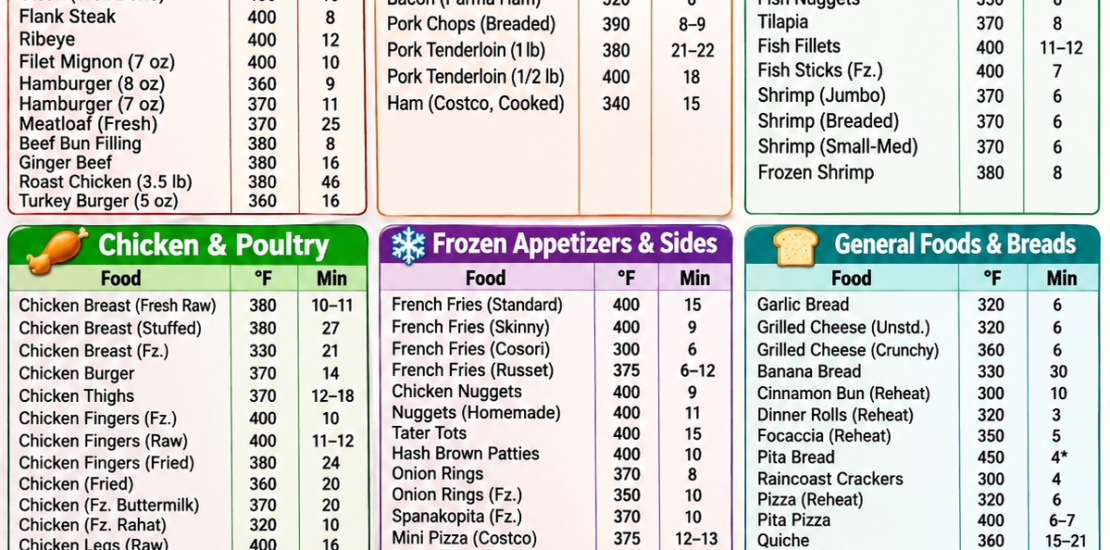
If you use an air fryer regularly, one question comes up again and again: What temperature should I use, and how many minutes should I cook it? That is exactly where an air fryer cheat sheet becomes useful. Instead of searching for a new recipe every time you want chicken wings, steak, salmon, French fries, vegetables, or a quick snack, you can use a reliable starting point and adjust it to your particular appliance.
The Home Tested Air Fryer Cheat Sheet shown in the accompanying image organizes foods into practical categories, including meat, pork, chicken and poultry, frozen appetizers and sides, fish and seafood, vegetables, breads, general foods, and desserts. The chart uses a simple °F/minutes format and marks certain foods in red when they should be shaken during cooking.
There is one important thing to understand before using any cooking chart: a time listed on a chart is not a guarantee that every air fryer will produce the same result. Air fryers vary in wattage, basket design, airflow, capacity, and heating performance. Food thickness, weight, quantity, starting temperature, and whether an ingredient is fresh or frozen can also make a significant difference.
For that reason, use this cheat sheet as a starting reference, not as a stopwatch. For meat, poultry and fish, always use an instant-read thermometer when appropriate and follow safe internal-temperature guidance.
Why an Air Fryer Cheat Sheet Makes Cooking Easier
An air fryer cheat sheet saves time because it puts the information you need in one place. Instead of remembering whether chicken wings need 380°F or 400°F, or whether frozen fries need 9 minutes or 15 minutes, you can quickly check the chart and get started.
The supplied home-tested chart is particularly useful because it does not simply group everything under broad headings. It separates foods according to preparation and size. For example, it lists fresh chicken breast, stuffed chicken breast, frozen stuffed chicken breast, chicken thighs, chicken legs, chicken fingers, chicken wings, chicken skewers, chicken burgers, fried chicken and several specialty chicken preparations.
That distinction is important.
A thin chicken tender and a thick stuffed chicken breast may contain the same basic ingredient, but they behave completely differently in an air fryer. Heat reaches a thin piece quickly, while a thick piece takes considerably longer for the center to heat.
The same principle applies to potatoes, fish, steak, pork and frozen foods.
Think of the cheat sheet as a road map. It gives you a sensible place to begin, but your food and your air fryer determine exactly when you arrive.
Fahrenheit to Celsius Air Fryer Conversion
If your air fryer uses Celsius while the recipe or chart uses Fahrenheit, these are the most useful conversions:
| Fahrenheit | Approximate Celsius |
|---|---|
| 300°F | 150°C |
| 320°F | 160°C |
| 330°F | 165°C |
| 340°F | 170°C |
| 350°F | 175°C |
| 360°F | 180°C |
| 370°F | 188°C |
| 375°F | 190°C |
| 380°F | 193°C |
| 390°F | 199°C |
| 400°F | 205°C |
| 450°F | 232°C |
For everyday air-fryer cooking, the most useful numbers to remember are 350°F ≈ 175°C, 375°F ≈ 190°C, 380°F ≈ 193°C, 390°F ≈ 200°C, and 400°F ≈ 205°C.
The 450°F setting shown for pita bread in the supplied chart deserves special attention. Do not set an air fryer to 450°F unless your particular appliance is designed to operate at that temperature. Many home air fryers have a lower maximum setting. In that situation, use the highest temperature allowed by the manufacturer and monitor the food closely.
How to Read the Air Fryer Cheat Sheet
The chart uses a straightforward format: temperature / minutes.
For example, 400 / 10 means approximately 400°F for 10 minutes.
Some entries also contain additional information about internal temperature or when to shake, flip, or turn the food.
That information should be treated separately from the cooking time.
The time tells you approximately how long the food may need in the air fryer.
The internal temperature tells you whether certain meats, poultry or fish have reached a safe cooking temperature.
These are not interchangeable measurements.
A chicken breast may look beautifully browned after 10 minutes but still need additional cooking. Conversely, a steak can be cooked safely without reaching 165°F simply because whole cuts of beef have a lower USDA minimum safe temperature than poultry.
For the best results, start checking food before the listed finishing time, particularly when using a new air fryer.
Why Food Size and Thickness Matter
Food thickness is one of the biggest reasons cooking times vary.
A thin chicken tender cooks much faster than a thick stuffed chicken breast. A skinny French fry cooks faster than a thick-cut fry. A small shrimp cooks faster than a large shrimp. A thin steak cooks faster than a thick filet.
The supplied chart illustrates this repeatedly.
For example, it lists fresh chicken breast around 380°F for 10–11 minutes, while stuffed fresh chicken breast is listed around 380°F for 27 minutes.
That is not necessarily a contradiction. The foods have different structures and thicknesses.
When using the cheat sheet, always consider:
- Weight
- Thickness
- Quantity
- Fresh or frozen
- Breaded or unbreaded
- Stuffed or plain
- Single layer or crowded basket
- Preheated or cold air fryer
These factors can make a bigger difference than changing the temperature by a few degrees.
Air Fryer Meat Cheat Sheet
The meat section of the supplied chart includes steaks, hamburgers, meatloaf, beef fillings, roast chicken and turkey burgers.
| Food | Chart Temperature | Chart Time |
|---|---|---|
| Steak, medium rare | 400°F | 6 min |
| Steak, medium | 400°F | 8 min |
| Steak, well done | 400°F | 10 min |
| Flank steak, medium rare | 400°F | 8 min |
| Ribeye | 400°F | 12 min |
| Filet mignon, 7 oz / 1.5 in | 400°F | 10 min |
| Hamburger, 8 oz | 360°F | 9 min |
| Hamburger, 7 oz | 370°F | 11 min |
| Meatloaf, fresh | 370°F | 25 min |
| Beef bun filling | 380°F | 8 min |
| Raw ginger beef | 380°F | 16 min |
| Whole chicken, approximately 3.5 lb | 380°F | 46 min |
| Turkey burger, 5 oz | 360°F | 16 min |
These times are chart references rather than guaranteed doneness times.
For steaks, thickness is especially important. A thin steak can cook much faster than a thick filet even at the same temperature.
For whole cuts of beef, USDA guidance recommends a minimum internal temperature of 145°F, followed by at least a 3-minute rest.
For ground beef, including hamburgers and meatloaf, the USDA minimum is 160°F.
That means the chart’s time should be used to get you close, but the thermometer should determine whether the meat has reached the appropriate internal temperature.
Steak: Don’t Confuse Cooking Preference With Food Safety
The image gives separate entries for medium rare, medium and well-done steak. That is useful because people have different preferences.
However, the internal-temperature information should not be confused with the USDA minimum safety guidance.
For whole cuts of beef, USDA recommends 145°F with a 3-minute rest.
A person who prefers a more well-done steak can cook it to a higher internal temperature.
The key point is that 165°F is not the universal minimum for steak.
That distinction is important because the original chart contains several internal-temperature annotations that appear to use 165°F for beef preparations. Those numbers should not be presented as universal food-safety requirements.
Air Fryer Pork Cheat Sheet
The supplied chart contains several pork and ham preparations.
| Food | Chart Temperature | Chart Time |
|---|---|---|
| Thin-cut bacon | 320°F | 6 min |
| Pancetta | 320°F | 10 min |
| Parma ham | 320°F | 6 min |
| Breaded/boneless pork chops | 390°F | approximately 8–9 min |
| Pork tenderloin, 1 lb | 380°F | 21–22 min |
| Pork tenderloin, ½ lb | 400°F | 18 min |
| Cooked Costco ham | 340°F | 15 min |
The pork-chop entry in the image appears visually ambiguous, showing “9-8” rather than a conventional increasing range. Because the original image is unclear, it is better not to convert that into an exact unsupported number.
For raw pork chops and pork tenderloin, USDA recommends a minimum internal temperature of 145°F followed by at least a 3-minute rest.
Ground pork is different and should reach 160°F.
Again, the chart time is only a starting point.
Bacon, Pancetta and Parma Ham
Thin bacon is listed at 320°F for approximately 6 minutes.
Pancetta is listed at 320°F for 10 minutes, while Parma ham is listed at approximately 320°F for 6 minutes.
These are relatively thin products, so they can move from lightly crisp to very crisp quickly.
Check them early during the first batch, especially if your air fryer has a powerful heating element.
Air Fryer Chicken and Poultry Cheat Sheet
Chicken is one of the most useful categories on the chart because it includes many different cuts and preparations.
| Chicken Food | Chart Temperature | Chart Time |
|---|---|---|
| Fresh raw chicken breast | 380°F | 10–11 min |
| Stuffed fresh chicken breast | 380°F | 27 min |
| Stuffed frozen chicken breast | 330°F | 21 min |
| Chicken burger | 370°F | 14 min |
| Chicken burger, thigh | 370°F | 12 min |
| Frozen/raw chicken fingers | 400°F | 10 min |
| Raw chicken fingers | 380°F | 24 min |
| Fried chicken | 300°F | 24 min |
| Buttermilk fried chicken | 370°F | 20 min |
| Frozen chicken pot pie | 330°F | 15 min |
| Raw chicken legs | 400°F | 16 min |
| Panko chicken legs | 380°F | 17 min |
| Garlic/lemon chicken legs | 380°F | 10 min |
| Chicken thighs | 370°F | 18 min |
| Breaded chicken wings | 380°F | 13 min |
| Chicken wings | 380°F | 15 min |
| Chicken skewers | 380°F | 8 min |
| Chicken souvlaki | 400°F | 8 min |
| Chicken pot pie, not frozen | 340°F | 15 min |
| Mongolian chicken wings | 380°F | 15 min |
There are some unusually large differences between entries, particularly for chicken fingers and specialty preparations. That is another reason to avoid treating the chart as a universal recipe.
For raw poultry, the USDA minimum internal temperature is 165°F. This applies to whole poultry, pieces and ground poultry.
A thermometer is especially useful for thick chicken breasts, stuffed chicken, chicken thighs and larger pieces.
Chicken Breast, Thighs and Wings
Fresh chicken breast is listed at approximately 380°F for 10–11 minutes in the chart.
Stuffed fresh chicken breast is listed at approximately 380°F for 27 minutes.
The difference is a perfect demonstration of why thickness matters.
Chicken thighs appear in several versions and are generally listed around 370°F for approximately 12–18 minutes.
Chicken wings are listed around 380°F, with breaded wings at approximately 13 minutes and another chicken-wing entry at approximately 15 minutes.
For crisp wings, leave enough room for hot air to circulate around the pieces. If the basket is packed tightly, the chicken may cook without developing the same crisp exterior.
Air Fryer Frozen Foods Cheat Sheet
The frozen-food section is one of the most useful parts of the supplied chart.
| Frozen Food | Chart Temperature | Chart Time |
|---|---|---|
| French fries, standard | 400°F | 15 min |
| French fries, skinny | 400°F | 9 min |
| French fries, Cosori | 300°F | 6 min |
| French fries, Russet | 375°F | 6–12 min |
| Chicken nuggets | 400°F | 9 min |
| Homemade/light-frozen chicken nuggets | 400°F | 11 min |
| Tater tots | 400°F | 15 min |
| Hash brown patties | 400°F | 10 min |
| Onion rings | 370°F | 8 min |
| Frozen onion rings | 350°F | 10 min |
| Frozen spanakopita | 370°F | 10 min |
| Mini Costco pizza | 375°F | approximately 12–13 min |
| Panko prawns | 400°F | 7 min |
| Taquitos | approximately 370–380°F | 6 min |
| Jalapeño poppers | 320°F | 11 min |
| Frozen lasagna | 320°F | 11 min |
| Large egg rolls | 400°F | 12 min |
| Sweet potato tempura | 400°F | 10 min |
| Yam fries | 400°F | 11 min |
One of the most useful lessons here is that frozen foods do not all require 400°F.
The chart ranges from approximately 300°F to 400°F for different products.
Always check the package instructions when available. If the manufacturer provides air-fryer directions, those should take priority over a generic chart.
French Fries
The chart contains several different French-fry entries:
- Standard fries: 400°F for 15 minutes
- Skinny fries: 400°F for 9 minutes
- Russet fries: 375°F for 6–12 minutes
- One Cosori-specific entry: 300°F for 6 minutes
These differences should not be treated as mistakes simply because they are different.
They may reflect differences in product, cut, appliance or preparation.
The important takeaway is that thin fries generally cook faster than thick fries, and a crowded basket can extend the time needed for crisping.
Shake fries during cooking when indicated by the chart or recipe.
Air Fryer Fish and Seafood Cheat Sheet
The supplied chart contains salmon, fish nuggets, tilapia, fish fillets, fish sticks and several shrimp preparations.
| Seafood | Chart Temperature | Chart Time |
|---|---|---|
| Salmon fillet, 6 oz | 350°F | 6 min |
| Salmon steak, 6 oz | 360°F | 12 min |
| Fish nuggets | 350°F | 6 min |
| Tilapia | 370°F | 8 min |
| Fish fillet | 400°F | 11–12 min |
| Frozen fish sticks | 400°F | 7 min |
| Jumbo shrimp | 370°F | 6 min |
| Breaded shrimp | 370°F | 6 min |
| Small-medium shrimp | 370°F | 6 min |
| Frozen shrimp | 380°F | 8 min |
These times are useful as starting points, but seafood thickness can vary substantially.
The 6-minute salmon fillet entry, for example, should not be interpreted as a guarantee that every 6-ounce salmon fillet will be fully cooked after exactly six minutes.
For fish, USDA consumer guidance recommends 145°F internal temperature.
That is more useful for safety than a fixed timer.
The chart’s internal-temperature annotations that suggest 160°F for some fish should therefore not be presented as the universal minimum safety temperature for fish.
Air Fryer Vegetable Cheat Sheet
The vegetable section contains several useful starting points.
| Vegetable | Chart Temperature | Chart Time |
|---|---|---|
| Broccoli | 300°F | 6 min |
| Broccoli, another preparation | 380°F | 10 min |
| Cauliflower | 350°F | 10 min |
| Zucchini | 350°F | 6 min |
| Brussels sprouts | 300°F | 10–14 min |
| Roasted mushrooms | 400°F | 4 min |
| Stuffed mushrooms | 300°F | 9 min |
| Sliced roasted radishes | 400°F | 8 min |
| Whole roasted radishes | 390°F | 10 min |
The chart specifically marks roasted mushrooms for shaking at approximately the 2-minute point.
That is a useful reminder that small foods benefit from movement during cooking.
Vegetables should generally be cut into similar-sized pieces so that they finish at approximately the same time.
Dry them before adding oil whenever possible. Excess moisture can encourage steaming rather than browning.
Air Fryer Breads, Sandwiches and General Foods
The supplied chart also includes bread, sandwiches, pizza, crackers, reheated foods and several other everyday items.
| Food | Chart Temperature | Chart Time |
|---|---|---|
| Garlic bread | 320°F | 6 min |
| Grilled cheese, untested | 320°F | 6 min |
| Grilled cheese, crunchy | 360°F | 6 min |
| Banana bread | 330°F | 30 min |
| Reheated cinnamon bun | 300°F | 10 min |
| Reheated dinner rolls | 320°F | 3 min |
| Reheated focaccia | 350°F | 5 min |
| Pita bread | 450°F | 4 min |
| Raincoast crackers | 300°F | 4 min |
| Reheated pizza | 320°F | 6 min |
| Pita pizza | 400°F | 6–7 min |
| Quiche | 360°F | 15–21 min |
| Reheated tortilla pie | 360°F | 20 min |
| Toasted nuts | 300°F | 5 min |
| Wieners | 400°F | 5 min |
| Fresh spanakopita | 300°F | 5 min |
| Reheated spanakopita | 300°F | 6 min |
The 450°F pita entry deserves another reminder: only use 450°F if your air fryer specifically supports that temperature.
For reheated foods, the chart is best understood as a texture and timing reference. Food safety still matters. USDA guidance recommends reheating leftovers to 165°F.
Air Fryer Desserts Cheat Sheet
The dessert section demonstrates that an air fryer can handle more than savory foods.
| Dessert | Chart Temperature | Chart Time |
|---|---|---|
| Cupcakes | 300°F | 15 min |
| Cake | 300°F | 30 min |
| Soufflé | 320°F | 14 min |
| Bread pudding | 350°F | 56 min |
| Reheated bread pudding | 350°F | 20 min |
Baked goods need more attention than fries because the exterior can brown while the center is still undercooked.
For cakes, cupcakes and bread pudding, use a toothpick or cake tester when appropriate rather than assuming the dessert is ready simply because the timer has ended.
When Should You Shake the Air Fryer Basket?
The supplied image states that red information indicates “shake” mode.
This is particularly useful for small foods such as French fries, nuggets, tater tots, roasted vegetables, mushrooms and similar ingredients.
Shaking redistributes the food so different surfaces are exposed to hot air.
For larger foods such as steak, chicken breast, pork chops or fish fillets, turning or flipping is generally more appropriate than shaking.
A simple rule is:
Small pieces → shake.
Large pieces → turn or flip when necessary.
Not every food requires movement. If a recipe specifically says not to disturb an item during the first part of cooking, follow that instruction.
How to Get Better Results From This Air Fryer Cheat Sheet
The best way to use this chart is to combine the listed temperature and time with observation.
Start with the chart’s setting. Then check the food before the listed finish time.
If the food needs more color or tenderness, continue cooking in short increments. Adding two or three minutes is much easier than trying to rescue food that has already burned.
Avoid overcrowding the basket. Air frying depends on moving hot air, so food needs enough space for that air to reach its surfaces.
For crispy food, dry the ingredients well before cooking. A small amount of oil can help browning, but excessive oil is unnecessary.
Shake or turn food when appropriate.
Most importantly, learn your individual air fryer.
Your first batch gives you information. Your second batch gives you an adjustment. After a few batches, you may discover that your machine consistently cooks certain foods faster or slower than the chart.
That is when a generic cheat sheet becomes a genuinely personal kitchen reference.
Food Safety: The Timer Is Not the Final Authority
This is the most important correction to the original article.
Cooking time and safe internal temperature are two different things.
A time such as 380°F for 15 minutes is a cooking starting point. It does not prove that every piece of chicken cooked for 15 minutes is safe.
USDA guidance recommends:
| Food | Minimum Internal Temperature |
|---|---|
| Beef, pork, lamb and veal steaks/chops/roasts | 145°F + 3-minute rest |
| Ground beef, pork, lamb and veal | 160°F |
| Chicken and turkey | 165°F |
| Fish | 145°F |
This distinction also explains why some of the internal-temperature annotations printed on the supplied chart should not be copied into an article as universal safety rules.
For example, a steak does not have to reach 165°F to satisfy the USDA minimum. A whole cut of beef can reach the recommended minimum at 145°F with a three-minute rest.
Similarly, fish does not universally require 160°F; USDA consumer guidance gives 145°F for fish.
For poultry, however, 165°F remains the appropriate minimum.
A digital food thermometer is therefore one of the most useful tools you can keep alongside your air fryer.
Common Air Fryer Mistakes to Avoid
The first mistake is treating the chart as an exact formula.
A chart cannot know the thickness of your chicken breast, the amount of fries in your basket, the power of your air fryer, or the temperature of your ingredients when they enter the basket.
The second mistake is overcrowding.
A full basket may save you from cooking two batches, but it can also prevent proper airflow and produce food that is cooked but not crisp.
The third mistake is ignoring the difference between fresh and frozen foods.
The supplied chart includes separate entries for many fresh and frozen products, and those differences should be respected.
The fourth mistake is using the chart’s internal-temperature notes as a replacement for current food-safety guidance.
For meat, poultry and fish, use current safe-temperature recommendations and a thermometer.
Finally, do not assume that every air fryer can reach every temperature printed on a generic chart. The 450°F pita entry is a good example. Always stay within the temperature range specified by your appliance manufacturer.
Air Fryer Cheat Sheet: Quick Reference
Here are some of the most useful entries from the supplied chart in one convenient table:
| Food | °F | Minutes |
|---|---|---|
| Steak, medium rare | 400°F | 6 |
| Steak, medium | 400°F | 8 |
| Steak, well done | 400°F | 10 |
| Hamburger, 8 oz | 360°F | 9 |
| Bacon, thin cut | 320°F | 6 |
| Pork tenderloin, 1 lb | 380°F | 21–22 |
| Fresh chicken breast | 380°F | 10–11 |
| Chicken burger | 370°F | 14 |
| Chicken thighs | 370°F | 18 |
| Chicken wings | 380°F | 15 |
| Chicken skewers | 380°F | 8 |
| Standard French fries | 400°F | 15 |
| Skinny French fries | 400°F | 9 |
| Chicken nuggets | 400°F | 9 |
| Tater tots | 400°F | 15 |
| Hash brown patties | 400°F | 10 |
| Onion rings | 370°F | 8 |
| Salmon fillet, 6 oz | 350°F | 6 |
| Tilapia | 370°F | 8 |
| Jumbo shrimp | 370°F | 6 |
| Broccoli | 380°F | 10 |
| Cauliflower | 350°F | 10 |
| Zucchini | 350°F | 6 |
| Roasted mushrooms | 400°F | 4 |
| Garlic bread | 320°F | 6 |
| Grilled cheese | 360°F | 6 |
| Reheated pizza | 320°F | 6 |
| Cupcakes | 300°F | 15 |
| Cake | 300°F | 30 |
| Soufflé | 320°F | 14 |
Important: These are the chart’s reference times, not guaranteed cooking times. Check the food as it cooks and verify internal temperatures when food safety requires it.
Conclusion
A good air fryer cheat sheet in °F and minutes can make everyday cooking much easier. The supplied Home Tested Air Fryer Cheat Sheet is especially useful because it covers a broad selection of foods, from steak, burgers, bacon and pork tenderloin to chicken, French fries, seafood, vegetables, bread, pizza and desserts.
The biggest lesson, however, is that the numbers should be treated as starting points rather than absolute rules.
The chart itself demonstrates why. Skinny fries and standard fries have different cooking times. Fresh chicken breast and stuffed chicken breast have dramatically different times. Salmon fillets and salmon steaks are listed differently. Even broccoli has more than one temperature-and-time combination.
That variation is normal.
For the best results, start with the chart’s temperature and time, then adjust according to your food and your air fryer. Shake small foods when indicated, avoid overcrowding, and check thicker foods before assuming they are finished.
Most importantly, separate cooking time from food safety. USDA guidance recommends 145°F with a three-minute rest for whole cuts of beef, pork, lamb and veal; 160°F for ground meats; 165°F for poultry; and 145°F for fish.
Once you combine the cheat sheet with a food thermometer and a little experience, air-fryer cooking becomes much more predictable.
The ultimate goal is not to memorize every number.
It is to understand the pattern:
Choose the right temperature. Start with the chart time. Give the food enough airflow. Shake or turn when appropriate. Check early. And use internal temperature when safety matters.
Frequently Asked Questions
Do I need to preheat my air fryer?
Not necessarily. Some recipes and appliances benefit from preheating, particularly when you want consistent browning or when the cooking time is very short. If the manufacturer or recipe recommends preheating, follow that instruction. If you are using this cheat sheet as a general reference, remember that starting with a cold basket may slightly change the cooking time.
What does the red information on the cheat sheet mean?
The heading on the supplied image states that red indicates “shake” mode. This means the food should generally be shaken or redistributed during cooking. This is particularly useful for fries, nuggets, vegetables, mushrooms and other small foods.
Can I use these times with any air fryer?
Use them as starting points rather than guarantees. Air fryers differ in wattage, airflow, basket size and heating performance. The quantity and thickness of the food can also change cooking time. Check your food early the first time you prepare it.
Why does my food cook faster than the chart says?
Your air fryer may be more powerful or have more efficient airflow than the appliance used for the chart. You may also be cooking a smaller quantity or thinner pieces. If your food consistently finishes early, begin checking several minutes before the chart’s listed time.
Should I shake French fries?
Yes, shaking can help distribute the fries and expose different surfaces to hot air. The supplied chart identifies certain foods for “shake” mode. Avoid shaking delicate foods if doing so could damage their coating or structure.
What temperature should chicken reach?
Raw chicken should reach an internal temperature of 165°F (74°C). Cooking time varies according to the size, thickness and preparation of the chicken, so use the chart as a starting point and a thermometer as the safety check.
What temperature should steak reach?
For whole cuts of beef, USDA recommends a minimum internal temperature of 145°F (63°C) followed by at least a three-minute rest. You can cook steak to a higher temperature according to your preferred level of doneness.
What temperature should fish reach?
USDA consumer guidance recommends 145°F (63°C) for fish. The exact air-fryer temperature and cooking time can vary according to the type and thickness of the fish.
Can I use the 450°F setting shown for pita bread?
Only if your air fryer is specifically designed to operate at 450°F. Many household air fryers have lower maximum temperatures. Never exceed your appliance manufacturer’s stated temperature range.
Can I cook frozen foods directly in the air fryer?
Many frozen foods are designed to be cooked directly from frozen, including products such as fries, nuggets, onion rings, fish sticks and other frozen appetizers. Always check the package directions when available because different products have different requirements.
Why are my fries not crispy?
The most common causes are overcrowding, excess moisture and insufficient airflow. Try cooking a smaller batch, dry fresh potatoes thoroughly before cooking, and shake the basket during cooking when appropriate. Frozen fries may also require a different time depending on their thickness and brand.
Does reheating food in an air fryer make it safe?
Reheating time and food safety are separate issues. For leftovers, USDA recommends reheating them to 165°F. The times shown on the cheat sheet should therefore be treated as practical starting points for reheating texture and temperature, not as guarantees of food safety.
Is this cheat sheet exact?
No. It is best used as a reference guide. The supplied image provides useful temperature-and-time combinations, but air-fryer performance varies. Food thickness, quantity, starting temperature and appliance design can all affect the result.
The simplest air-fryer rule to remember:
The chart gives you a starting point. Your food tells you when it is done.

: Complete Cooking Times Guide)
: Complete Cooking Times Guide)