

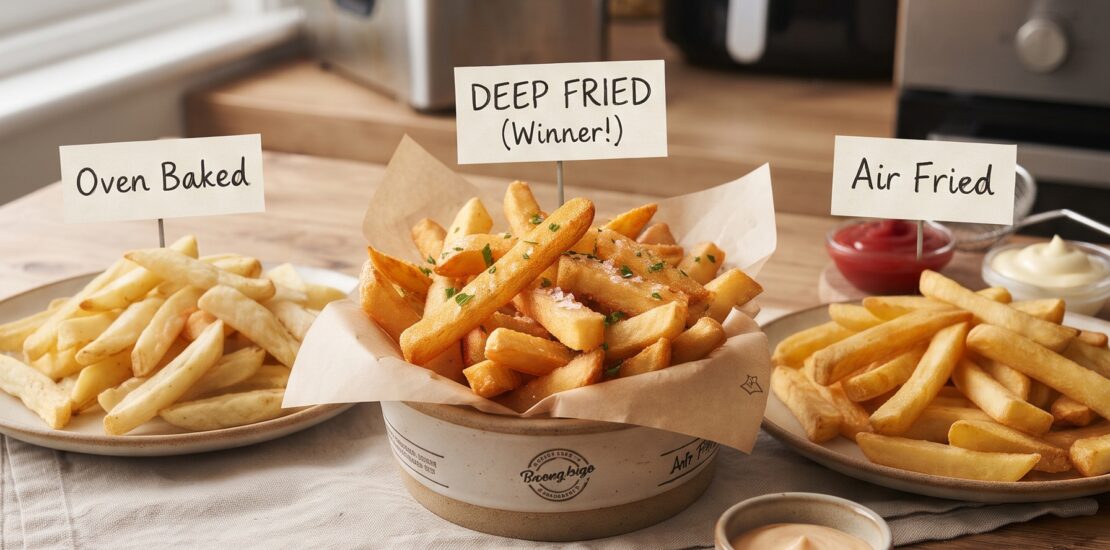
Air fryer vs deep fryer vs oven: discover which method makes the crispiest frozen chips, cooks fastest, and costs less.
Why the Way You Cook Frozen Chips Makes Such a Difference
There’s something irresistible about a plate of perfectly cooked chips. That satisfying crunch when you bite into one, followed by a fluffy, steaming potato centre, can transform even the simplest meal into proper comfort food. Whether you’re serving frozen chips alongside fish, burgers, chicken or simply dipping them into your favourite sauce, getting the texture right makes all the difference. Yet if you’ve ever pulled a tray of disappointing, pale chips from the oven, you’ll know that achieving that golden perfection isn’t always as easy as the packaging suggests.
The real question is surprisingly simple: what is the best way to cook frozen chips? Should you trust your traditional oven, reach for a deep-fat fryer or put your air fryer to work? Each appliance promises something slightly different. Deep frying is associated with the familiar crunch of takeaway chips, oven cooking offers convenience and space, while air frying promises a quicker route to crispiness without needing a vat of hot oil. They can all make an enjoyable plate of chips, but they’re not equally suited to every household.
The way chips cook comes down to heat transfer, moisture loss and the surface of the potato. Deep frying surrounds the chips with hot oil, rapidly heating their exterior. An air fryer circulates hot air around the food, which can help moisture escape from the surface and encourage browning. A conventional oven works through similar dry-heat principles, but its larger cooking chamber and different airflow patterns can affect both speed and evenness. These differences help explain why the same bag of frozen chips can produce surprisingly different results.
Published appliance testing provides some useful clues about the winner. In research updated in 2026, consumer organisation Which? cooked 320g of frozen chips in an air fryer and an electric oven. The air fryer completed the job in 23 minutes and used 0.287 kWh of electricity, compared with 33 minutes and 0.863 kWh for the oven. The cooking quality was mixed for both appliances, so the air fryer was not an automatic winner for texture alone. But on speed and running costs for a small portion, the advantage was difficult to ignore.
How to Compare Three Frozen Chip Cooking Methods Fairly
Before declaring any appliance the champion of frozen chips, it’s important to establish what a fair comparison actually looks like. Frozen chips come in countless shapes and styles, including thick-cut chips, skinny fries, crinkle-cut varieties and heavily coated products designed to become especially crispy in the oven. Different brands also use different levels of pre-frying, seasoning and surface coatings. Comparing one type in a deep fryer with a completely different product in an air fryer wouldn’t tell us much about the appliances themselves.
A proper kitchen experiment would begin with one bag of the same frozen chips, divided into three equal portions. Each portion should go straight from the freezer into its designated cooking appliance, following the product’s instructions for that method where available. The air fryer and oven should be prepared according to their operating guidance, and the deep fryer should be used only if the chips are suitable for deep frying. It’s also important to include any required preheating time. After all, nobody wants a comparison that conveniently ignores the ten minutes spent waiting for an oven to reach temperature.
The most useful assessment should go beyond simply asking whether the chips taste good. Crispiness matters, but so do the soft centres, even browning, cooking time, convenience, oil requirements and cleaning afterwards. There’s also the issue of quantity. Cooking a small bowl for one person is very different from preparing enough chips for a family of six. An air fryer that performs beautifully with a modest portion can struggle when its basket is overloaded, while a spacious oven may become much more practical as portion sizes increase.
For this article, the comparison draws on documented testing, appliance guidance and the practical differences between cooking techniques. Where the evidence supports a clear finding, such as lower electricity consumption for a tested air-fryer portion, we can be specific. Where individual results are likely to vary, particularly the taste and crunch of different frozen chip brands, it’s better to explain the trade-offs than invent a perfect result. That gives you something more useful than a dramatic taste-test story: a reliable way to decide which method deserves a place in your own kitchen.
Method 1 – Air-Frying Frozen Chips
Air frying has become one of the most popular ways to prepare frozen chips, and it’s easy to understand the attraction. Instead of filling a large oven with hot air or heating a substantial quantity of cooking oil, you use a compact appliance designed to circulate heat around your food. For a quick lunch or an easy evening meal, this arrangement can be wonderfully convenient. You take your chips out of the freezer, spread them in the basket, select the appropriate setting and let the appliance do most of the work.
The biggest advantage of air-fried frozen chips is the balance between crispiness, speed and convenience. As the circulating hot air heats the chips, moisture begins escaping from their surfaces. This helps the exterior become firmer and crispier while the potato inside heats through. The results depend on how well the appliance distributes heat and how much space you leave between the chips. If they’re piled too high, some pieces may brown nicely while others remain pale or soft. That’s why shaking the basket during cooking makes such an important difference.
Many frozen chip products already contain some oil from their manufacturing process, meaning additional oil may not be necessary. A small amount can improve the finish for certain products, but adding too much can leave the surface greasy rather than beautifully crisp. Start with the instructions on the packet and the recommendations for your appliance, then adjust only when needed. For example, thinner fries generally need less cooking time than thick, chunky chips. An air fryer is efficient, but it’s not a magical machine that produces identical results from every potato product.
There is one significant limitation: capacity. A compact air fryer may be ideal for one or two people but frustrating when you need enough chips for a large family. Overcrowding reduces the space available for circulating air, and cooking several batches can cancel out much of the time and energy advantage. In Which?’s published frozen-chip comparison, some chips at the bottom of the air-fryer basket were undercooked, despite the cooking process including shaking or stirring. Even so, for a modest portion and a convenient everyday meal, the air fryer is an exceptionally strong contender.
Method 2 – Deep-Frying Frozen Chips
Deep frying is the traditional route to the classic chip-shop experience. There is a reason people love chips with a crisp outside and a beautifully soft middle, especially when they’re freshly cooked and sprinkled with salt. When you immerse suitable frozen chips in hot oil, heat moves rapidly into the potato’s surface. Moisture evaporates, the outer layer firms up and the chips develop the characteristic fried texture that many people associate with takeaway food. For pure indulgence, it’s difficult to dismiss the appeal.
The main attraction of deep frying is that it can create a very satisfying, well-developed crust. Unlike an oven or air fryer, where hot air transfers heat to the chips, deep frying brings hot oil into direct contact with much of their surface. This promotes rapid heat transfer and can deliver a consistent finish when the oil temperature, portion size and cooking instructions are appropriate. However, temperature control matters enormously. Oil that is too cool can produce disappointing results, while excessively hot oil may brown the surface before the centre is properly cooked.
Deep frying also comes with practical drawbacks. You need to heat the oil before cooking, monitor the process carefully and allow the appliance to cool before cleaning. Some oil is retained by the food, although the amount depends on the chip product and frying conditions. You must also dispose of used oil responsibly rather than pouring it down the sink. What feels like a delicious treat on a Friday evening can quickly become an inconvenient routine if you simply want a small portion of chips for lunch.
Safety is especially important when dealing with frozen foods and hot oil. Only deep-fry frozen chips if the product instructions permit it, and use a thermostatically controlled fryer according to its manufacturer’s guidance. Loose ice and excess surface moisture can cause dangerous splattering when they contact hot oil. Never overcrowd the fryer, leave it unattended or pour water onto an oil fire. UK fire-safety guidance specifically recommends thermostatically controlled equipment and careful management of hot oil. Deep frying may be appealing for its texture, but the additional oil, supervision and cleanup prevent it from being the easiest everyday choice.
Method 3 – Cooking Frozen Chips in the Oven
Before air fryers became kitchen favourites, the conventional oven was the obvious choice for countless frozen-chip dinners. It’s still one of the simplest options, especially when you’re already using the oven to cook something else. Spread your frozen chips across a baking tray, put them into the preheated oven and follow the cooking instructions on the packaging. There’s no special countertop appliance required and no large container of hot oil to manage. For many households, that familiarity alone makes oven cooking attractive.
The oven’s biggest strength is its capacity. A spacious baking tray allows you to distribute a generous serving of chips, while multiple shelves offer additional cooking space if your oven and recipe allow it. This becomes particularly useful when preparing a family dinner or cooking chips alongside fish fingers, breaded chicken or another oven-friendly main course. Instead of preparing several air-fryer batches, you may be able to cook the entire meal in one appliance. Although an oven takes longer to preheat, its ability to handle larger quantities can make it surprisingly practical.
Texture, however, can be inconsistent. If chips are packed too closely together, moisture can accumulate and slow the development of a crispy surface. A baking tray that’s too crowded may leave some pieces pale while the thinner ends become excessively browned. Turning the chips during cooking can help expose different surfaces to the heat, while distributing them in a single layer gives them a better chance of browning evenly. The design of your oven also matters. A well-performing fan-assisted oven may produce a different result from an older conventional appliance.
The published Which? comparison found that its electric oven used more energy and took longer than its air fryer to cook the same 320g portion of frozen chips. Interestingly, the oven earned a slightly higher cooking-quality score, although some chips were too crispy and others less evenly cooked. That highlights an important point: a faster appliance isn’t necessarily the best at every aspect of cooking. If you’ve already got the oven running or you’re preparing chips for several people, it remains a sensible, convenient option.
Air Fryer vs Deep Fryer vs Oven – The Results Compared
Now comes the interesting part. When choosing between the three cooking methods, it’s tempting to focus on a single feature, such as how crunchy the chips become. But cooking quality is only one piece of the puzzle. A method that produces an excellent crust may demand more effort, more oil and more cleaning than you’re willing to deal with on a busy weekday. Similarly, a cheaper appliance may become less economical when you need to cook multiple batches.
The following comparison summarises the practical differences between these methods. The recorded air-fryer and oven figures are taken from the Which? test of 320g of frozen chips; the deep-fryer column describes general characteristics rather than invented measurements from the same experiment. That distinction matters because different appliances, products and oil-heating requirements can change the outcome. Treat the comparison as a buying and cooking guide rather than a universal laboratory ranking.
| Feature | Air fryer | Deep fryer | Conventional oven |
|---|---|---|---|
| Crispiness potential | Very good with proper spacing | Excellent traditional fried crust | Good, but can vary |
| Cooking time in cited test | 23 minutes | Not measured in that test | 33 minutes |
| Energy used in cited test | 0.287 kWh | Not measured | 0.863 kWh |
| Electricity cost in cited test | About 8p | Not measured | About 23p |
| Extra cooking oil | Usually little or none | Requires substantial frying oil | Usually little or none |
| Cooking capacity | Basket-dependent | Fryer-dependent | Usually generous |
| Cleanup | Generally straightforward | More involved | Usually straightforward |
| Best use | Small, everyday portions | Traditional fried texture | Large portions and full meals |
Test figures reflect the specific appliances, portion and electricity tariff used by Which?, updated for October 2026. They are not guaranteed results for every household.
Electricity used to cook 320g of frozen chips in the published test
0 kWh0.25 kWh0.5 kWh0.75 kWh1 kWhAir fryerElectric oven
Which? appliance comparison, including preheating where needed. Deep frying was not included in this measurement.
The numbers show why the air fryer is such an attractive option for modest portions. It used roughly one-third as much electricity as the tested oven and completed the cooking sooner. That doesn’t mean every air fryer will use precisely the same amount of energy, nor does it mean a deep fryer cannot compete on cooking speed. It simply demonstrates that a compact air fryer can offer genuine efficiency advantages. If your priorities are convenience, manageable running costs and enjoyable chips, the air fryer starts to look like the most balanced choice.
Which Method Makes the Crispiest Frozen Chips?
Crispiness is probably the quality most people care about when discussing chips. Nobody gets particularly excited about a floppy chip with a damp exterior and a cold or dense centre. The ideal chip has a delicate crunch when you bite into it, followed by a soft, fluffy texture that makes the potato feel satisfying rather than dry. Achieving that contrast depends on how effectively the cooking method removes moisture from the surface while heating the interior.
Deep frying has a strong advantage when the goal is a traditional fried crust. Hot oil transfers heat efficiently and surrounds the food, creating conditions that can develop a well-defined exterior. This is why deep-fried chips are so often associated with a rich, satisfying texture. However, they’re not guaranteed to be superior in every situation. If the oil temperature falls too much after adding a large portion, or if the chips are unsuitable for that method, the results can be disappointing. Good frying technique matters as much as the appliance.
Air frying is a particularly impressive alternative because it can produce a pleasantly crisp surface without requiring immersion in oil. The trick is allowing the air to circulate properly. Chips need enough space for moisture to escape, and shaking them during cooking helps prevent those at the bottom from remaining underdone. Some frozen chips are even formulated with coatings that become especially crunchy under circulating hot air. For those products, an air fryer may deliver exactly the texture you want without the fuss of traditional deep frying.
Oven cooking can also make wonderfully crispy chips, especially when the tray is properly spaced and the oven temperature is correct. Still, differences in airflow and how the tray transfers heat can lead to uneven results. A conventional oven may produce beautifully browned tips alongside softer central pieces, particularly with a crowded tray. Ultimately, the crispiness winner depends on the chip brand and cooking technique. Deep frying remains the traditional choice for a pronounced fried crust, while air frying offers a persuasive compromise between crunch and convenience.
Which Cooking Method Is the Fastest?
When you’re hungry and dinner is already running late, cooking time suddenly becomes a very important consideration. Nobody wants to spend half an hour watching frozen chips slowly turn golden when a quicker method could deliver similar results. But there’s a catch: cooking time isn’t just the number printed on the appliance display. You also need to consider preheating, preparing the equipment, handling the food and, when necessary, cooking a second batch.
Air fryers often perform particularly well with small portions because their compact cooking chambers heat up quickly. Some models require little or no preheating, although you should follow the manufacturer’s guidance. Once the chips are inside, rapidly circulating air encourages the cooking process without requiring an entire full-size oven to reach operating temperature. The 2026 Which? comparison recorded 23 minutes for the air fryer and 33 minutes for the electric oven, including preheating where necessary. That ten-minute difference is meaningful when you’re preparing a quick meal.
Deep frying can also be quick once the oil is at the correct temperature. The challenge is that heating a large quantity of oil takes time, and the process requires greater care. You cannot simply drop frozen chips into oil that hasn’t reached its recommended temperature and expect excellent results. A deep fryer’s capacity and recovery time between batches also influence the total preparation time. According to Which?’s broader air-fryer testing methodology, appliances vary significantly: some air fryers can cook four portions in around 20 minutes, while slower models take more than 45 minutes. Their oven and deep-fryer comparisons also show wide ranges rather than one universal winner.
The oven may appear to be the slowest choice, but that judgment changes when you’re preparing a large meal. Imagine cooking chips for six people in a small air fryer that only comfortably holds two portions at once. Three consecutive batches could take longer than one generous oven tray, depending on the appliances and portion sizes involved. If the oven is already hot because you’re roasting something else, the additional heating requirement may be minimal. For a small serving, the air fryer is frequently the fastest practical option, but the oven can become more efficient in terms of total meal preparation for a crowd.
Which Method Is Cheapest to Run?
With household expenses constantly competing for attention, the cost of cooking matters more than many people realise. Frozen chips themselves may be inexpensive, but using a relatively large appliance for a tiny portion can make an otherwise cheap meal less efficient. Energy consumption depends on power, operating time, heating cycles and appliance design. A device with a higher wattage rating isn’t automatically more expensive if it cooks the food substantially faster, which is why measured energy use is more informative than comparing wattage alone.
In the Which? frozen-chip experiment, the air fryer used 0.287 kWh of electricity, while the oven consumed 0.863 kWh. At the electricity rate used in its October 2026 calculations, those figures corresponded to approximately 8p and 23p respectively. That’s a saving of about 15p per cooking session. It might sound insignificant when you’re preparing one meal, but small differences can accumulate when an appliance is used regularly. Still, those figures relate to the particular appliances tested and should not be treated as fixed prices for every home.
Deep frying presents a different cost calculation because electricity isn’t the only expense. You also need to buy cooking oil, maintain the fryer and occasionally replace the oil when it is no longer suitable for use. The amount of oil needed and how many safe cooking sessions you get from it depend on the fryer and how it’s used. An air fryer and oven generally avoid that substantial oil requirement when cooking frozen chips already prepared for those methods. However, purchasing a new air fryer also involves an upfront cost that should be considered before claiming long-term savings.
There’s another important twist: household size. For an individual or couple, the air fryer may offer excellent value because it heats a relatively small cooking area. For a larger household, operating an oven once to prepare several portions might be more economical than running a small air fryer repeatedly. The same applies when you’re cooking multiple dishes simultaneously. So while the air fryer was the cheapest measured option in the cited small-portion test, it’s sensible to consider your usual cooking habits before deciding which appliance offers the best value overall.
Are Air-Fried Frozen Chips Healthier Than Deep-Fried Chips?
It’s easy to assume that anything cooked in an air fryer must automatically be healthier, but nutrition is rarely that simple. Air frying can reduce the amount of additional oil needed compared with traditional deep frying, potentially lowering the finished food’s fat and calorie content. That’s a meaningful advantage when you’re regularly preparing fried foods. However, frozen chips are often partially cooked in oil before packaging, and some products contain coatings, added salt or other ingredients. Switching appliances doesn’t erase what was already in the food.
The British Heart Foundation explains that air fryers can be a healthier cooking option because they often require much less oil. Its guidance also makes an important distinction: air frying doesn’t automatically remove fat, salt or sugar already present in a processed product. That means the healthiest choice depends on the ingredients, the portion size and the rest of your meal. A modest serving of air-fried chips alongside vegetables and a nutritious main course tells a different nutritional story from an oversized portion covered in salt and rich sauces.
Another consideration is acrylamide, a substance that can form when starchy foods such as potatoes are cooked at high temperatures. This isn’t exclusively a deep-frying issue; acrylamide can also develop during roasting, baking and air frying. The United States Food and Drug Administration advises cooking cut potato products to a golden-yellow colour rather than a dark brown colour to help reduce its formation. Longer cooking times and higher temperatures can increase acrylamide levels, making it unwise to pursue extremely dark, heavily browned chips simply for extra crunch.
For everyday meals, the best approach is to focus on balance rather than declaring one appliance a shortcut to healthy eating. Check the nutritional information on the frozen-chip packaging, prepare an appropriate portion and avoid adding more oil or salt than necessary. Cook until the chips are properly heated and golden rather than excessively browned. Deep-fried chips can still be enjoyed occasionally, but air frying and oven baking generally offer convenient ways to prepare chips with less added oil. The air fryer wins on the potential to avoid extra frying oil, although the oven can offer much the same nutritional benefit when the same product is cooked without additional fat.
Simple Tricks for Making Frozen Chips Extra Crispy
Even the best appliance won’t rescue badly prepared chips every time. If you’re struggling to achieve a golden finish, the solution may be simpler than replacing your oven or buying a more expensive air fryer. Frozen chips respond to small changes in spacing, temperature, timing and airflow. Once you understand those factors, it’s easier to improve the results without overcomplicating dinner. Here are the habits most worth adopting.
1. Cook from frozen when the packaging instructs you to. Don’t thaw chips unnecessarily, as that can change how they handle and cook. Follow the manufacturer’s guidance for the product and appliance.
2. Avoid overcrowding. Give the chips enough room for heat to circulate. A basket or baking tray packed too tightly can produce uneven cooking.
3. Shake or turn the chips. Redistributing them partway through cooking helps expose more surfaces to the heat.
4. Use the correct temperature. Higher isn’t always better. Excessive heat can darken the outside before the centre is properly cooked.
5. Be cautious with added oil. Many frozen chips are already prepared with oil. Check the packet before adding more.
6. Serve them promptly. Chips gradually lose their freshly cooked crispiness as they cool and moisture redistributes.
One particularly useful trick is to pay attention to how your appliance handles airflow. In an air fryer, chips stacked in a thick pile are less likely to cook evenly than those arranged loosely. In an oven, spreading chips across an appropriately sized tray allows more surfaces to receive heat. Different brands may need slightly different handling, so consider your first batch a chance to learn how that particular product behaves. There’s no need to obsess over a perfect arrangement, but making sure everything isn’t crowded into one corner can help.
It’s also worth resisting the temptation to keep cooking chips until they’re extremely dark. A deeper colour doesn’t always produce a better eating experience, and heavily browned potato products can contain more acrylamide. Aim for the golden finish recommended by the manufacturer instead. If your chips are already golden but still lack crunch, consider whether moisture, overcrowding or the chip formulation is responsible rather than simply increasing the temperature. That approach is more reliable than treating maximum heat as the answer to every cooking problem.
Finally, don’t underestimate the importance of serving time. Freshly cooked chips tend to be at their most satisfying immediately after they leave the appliance. Leaving them in a covered bowl can trap steam, causing their surfaces to soften. Place them onto plates promptly, add any seasoning you’d like and serve while they’re hot. With a few basic adjustments, frozen chips can develop a satisfying crunchy exterior and a soft potato centre whether you’re using an air fryer, oven or a suitable deep-fat fryer.
The Final Verdict – Which Cooking Method Wins?
After considering the available testing evidence and the practical strengths of all three methods, the air fryer is the best overall choice for cooking small portions of frozen chips at home. It combines relatively quick cooking with modest electricity consumption, generally requires little or no additional oil and avoids much of the cleanup associated with deep frying. For the everyday cook who simply wants an enjoyable plate of golden chips without turning dinner into a complicated project, those advantages are difficult to beat.
That doesn’t mean air frying produces the most delicious chip in every possible comparison. Deep frying has a genuine advantage when you’re specifically looking for a traditional fried crust and the richness associated with that method. The oven remains especially useful for larger households, generous portions and meals where several foods need cooking together. Even an outstanding air fryer can become inconvenient if you have to prepare three or four batches. The winner ultimately depends on what you’re cooking, how much you’re cooking and which qualities matter most to you.
The evidence also reminds us not to exaggerate the air fryer’s performance. In the published Which? test, the air fryer achieved clear savings on time and electricity but didn’t cook every chip perfectly. Some pieces were underdone, while the oven’s results were also uneven. Neither appliance earned an exceptional cooking-quality rating in that comparison. It’s therefore more accurate to say that air frying offered the stronger balance of performance and efficiency, rather than claiming it won a unanimous taste test.
So, which appliance deserves the crown? For a quick weeknight portion, choose the air fryer. For a traditional indulgent fried texture, a properly operated deep fryer still has its appeal. For a large family dinner, don’t overlook the trusty oven. But if you’re asking which single method makes the most sense for typical small-batch frozen-chip cooking, the air fryer takes the overall win thanks to its practical combination of speed, ease and running-cost advantages.
Conclusion
The humble frozen chip might seem like one of the simplest foods to prepare, but the cooking method can have a remarkable influence on the finished result. Whether you prefer thick, fluffy chips or thinner fries with a pronounced crunch, the appliance you choose affects how quickly the food cooks, how evenly it browns and how much effort is required. Deep frying brings traditional fried texture to the table, oven cooking offers generous capacity and familiarity, and air frying provides an appealing middle ground. None of these methods is automatically perfect, but each has strengths that suit different kitchens.
For most people cooking one or two servings, the air fryer stands out as the best overall method for frozen chips. Its compact cooking chamber can make meal preparation more efficient, particularly when compared with switching on a full-size oven for a small portion. Published testing supports the advantages in cooking time and energy consumption, although crispiness still depends on the brand of chips, basket loading and individual appliance. The air fryer won’t necessarily replace every other cooking method, but it can make preparing a quick side dish wonderfully convenient.
The real secret to excellent frozen chips is understanding how your appliance works and using it correctly. Follow the instructions, give the chips adequate space, shake or turn them when appropriate and aim for a delicious golden finish rather than excessive browning. Those simple habits can make a noticeable difference without demanding special ingredients or complicated techniques. And if you’re preparing dinner for a crowd, remember that the oven remains a valuable alternative with capacity that smaller air fryers cannot always match.
Ultimately, great chips should be enjoyable, convenient and suited to the meal you’re making. Deep frying may satisfy your cravings for a classic chip-shop-style treat, while oven baking remains dependable when there’s plenty to cook. But for a simple evening dinner, a quick lunch or a side dish for two, the air fryer makes a particularly convincing case. The overall winner is the air fryer—not because every chip will be perfect, but because it offers the best all-round balance of convenience, cooking speed and efficiency for small portions.
Frequently Asked Questions
1. Can You Cook Frozen Chips Straight From the Freezer?
Yes. Most commercially prepared frozen chips are designed to be cooked directly from frozen, provided you follow the manufacturer’s instructions. There’s usually no need to defrost them before putting them into an air fryer or oven. In fact, thawing a product that is intended to be cooked from frozen can change its texture and make it more difficult to achieve an evenly cooked, crisp finish. Keep the chips frozen until you’re ready to prepare them, and check the packaging for the correct method, temperature and time. If you’re using a deep fryer, make sure the specific product is suitable for deep frying and that there is no loose ice or excessive surface moisture that could cause dangerous splattering.
2. Do You Need to Add Oil to Frozen Chips in an Air Fryer?
Not necessarily. Many frozen chips have already been partially fried or coated with oil during manufacturing, so they may become nicely golden without any additional fat. Adding extra oil automatically isn’t always helpful and can make some products greasier than intended. The best approach is to read the packaging and begin with the recommended preparation method. For certain products, a light coating of oil may improve the finished texture, but the amount should remain modest. Air frying is particularly convenient because it doesn’t require the chips to be submerged in oil, making it a practical alternative to deep frying.
3. What Temperature Should You Use for Frozen Chips?
The ideal temperature depends on the type of frozen chips and the appliance you’re using. Some air-fryer chip instructions recommend temperatures around 180–200°C, while conventional oven instructions can vary according to whether the oven is fan-assisted. Deep frying uses different temperature controls, and the applicable food and appliance guidance should always take priority over generic recommendations. Thicker chips may require a different cooking time from thin fries, and certain coated products are designed for specific cooking methods. Rather than turning every appliance to its highest setting, follow the temperature printed on the packaging and adjust only as appropriate for your appliance. Aim for chips that are properly cooked and golden, not excessively dark.
4. Why Do Frozen Chips Sometimes Turn Out Soggy?
Soggy frozen chips are often the result of overcrowding, uneven heating or moisture that hasn’t escaped effectively during cooking. When too many chips are packed together, hot air cannot reach their surfaces as efficiently, especially in an air-fryer basket or on an overloaded baking tray. Some pieces may cook beautifully while others remain soft and pale. Shaking or turning the chips partway through cooking can help improve consistency. The product itself also plays a role, since different chip coatings and potato varieties behave differently. For better results, avoid overloading the appliance, use the recommended settings and serve the chips shortly after cooking instead of letting them sit where steam can soften the surface.
5. Is an Air Fryer Really Better Than an Oven for Frozen Chips?
For smaller portions, an air fryer can be a better everyday choice because it often cooks faster and uses less electricity than a conventional oven. Published testing from Which? supports that advantage, with its tested air fryer using approximately one-third of the electricity required by its oven to prepare the same portion of frozen chips. However, that doesn’t automatically make every air fryer better for every meal. A conventional oven can accommodate larger quantities, and it may be more practical if you’re cooking several dishes at once. Choose an air fryer for small, convenient portions and consider the oven for larger family meals. Both can produce delicious chips when used correctly.


